

What this article covers: A behind-the-scenes look at how a commercial animator’s working day actually unfolds, from morning check-ins through to client delivery, and what each stage means if you’re the one commissioning the animation.
Who this is for: Marketing managers, SME owners, brand managers, and training managers across Belfast, Northern Ireland, Ireland, and the UK who are weighing up whether to hire a professional animation studio.
Key takeaway: The daily structure behind commercial animation, tight review cycles, clear feedback loops, and disciplined project management, is what actually protects your budget, your deadline, and the quality of what lands in your inbox.
Expert insight: “Clients rarely need to know how an animation gets made. What they do need is confidence that the process behind it is disciplined enough to hit their deadline and their budget.” , Michelle Connolly, Founder and Director, Educational Voice
Quick facts:
- Educational Voice has produced over 3,300 educational animations for LearningMole, a platform with 246,000 YouTube subscribers and more than 16 million views.
- The studio is based in Belfast and works with clients across Northern Ireland, Ireland, and the wider UK.
- A typical commercial 2D animation project runs from initial brief to final delivery in around four to eight weeks.
Stepping into a commercial animator’s day means balancing creative instinct against commercial pressure. Every sketch, storyboard, and revision serves a paying client’s deadline, not just artistic ambition. At Educational Voice, a Belfast-based 2D animation studio, that balance shapes how the team plans each project, keeping quality high whilst respecting a client’s budget and timeline. It’s a rhythm most business owners never see up close.
“Commercial” animation differs from a feature film in almost every practical sense. Where a film production might spend months refining a single sequence, a commercial project usually has weeks, sometimes days, to move from brief to broadcast-ready output. Northern Ireland and the wider UK market rewards studios that can move fast without losing craft, which is exactly the discipline this article sets out to explain.
If you’ve never commissioned an animation before, the process can feel like a black box, you send a brief, and something finished eventually appears. This guide opens that box up. It follows a typical day inside a commercial animation studio, then translates each stage into what it means for you as a client, whether you’re briefing an explainer video, a training animation, or a sales piece.
The 09:00 Kick-off: Why the “Dailies” Matter for Your Project
The working day for most commercial animation teams starts with a short review meeting, often called “dailies.” This isn’t a formality; it’s the point where the previous day’s work gets checked against the brief before anyone moves forward.
A typical morning session covers three things: what got finished overnight or the day before, what’s blocking progress, and what needs a decision before work can continue. Common morning blockers include a client note that arrived late in the day and needs clarifying, a scene that doesn’t read clearly once it’s in motion, or a technical snag with a file handover between team members.
For a client, this matters more than it might seem. A studio that runs disciplined morning reviews catches small problems, a character moving oddly, a pace that drags, a brand colour that’s drifted, before they become expensive to fix later in the schedule. Educational Voice structures its own production days around this same principle: reviewing work early and often, rather than waiting for a big reveal at the end of a project, keeps a commercial animation on schedule and on brief.
Animators use this early part of the day to set priorities as well. If three scenes need attention and only one can realistically get finished before the next client check-in, the team decides which one matters most for keeping the whole project moving. That prioritisation, more than raw drawing speed, is often what separates a professional animator from someone animating as a hobby.
The dailies habit also does something less obvious: it builds a shared record of decisions. When a client asks weeks later why a particular scene reads a certain way, the team can point back to the specific morning that choice was made and why. That kind of traceability matters most on projects with several stakeholders, common in corporate training and financial services animation, where a compliance team, a marketing lead, and a project sponsor might all need to sign off before a scene is considered finished. Without a disciplined daily review, those approvals become harder to track, and rework tends to happen later in the schedule, when it’s far more expensive to fix.
Deep Work: The Anatomy of a Commercial Animation Pipeline
Once the morning review is done, the bulk of a commercial animator’s day is spent moving a project through a defined pipeline: storyboard, animatic, keyframes, in-between motion, and finishing. Each stage exists to catch a different kind of problem before it’s baked into the final render.
Storyboarding comes first and matters most. A storyboard is a rough, panel-by-panel plan of every shot in the animation, and it’s far cheaper to change a storyboard panel than to redo finished animation. Once a client signs off the storyboard, the team builds an animatic, a rough timed version of the whole piece, so pacing can be checked before any detailed drawing begins. You can see examples of this progression, from early sketch through to finished frame, across Educational Voice’s portfolio of finished projects.
From there, the pipeline moves into keyframing, plotting the key poses that define a movement, followed by the in-between motion that connects those poses smoothly. Finishing work, colour correction, sound design, and final compositing, comes last, once the client has approved the full animatic and every scene reads clearly on its own. Educational Voice runs this same sequence for every commercial project, whether it’s a sixty-second explainer video for a website, a longer educational animation built for a classroom, or a training animation designed to sit inside a company’s onboarding programme. The stages don’t change; only the scale and complexity of each one does.
The Software Stack: What Powers a Commercial Pipeline
Commercial studios typically rely on a mix of dedicated 2D animation software, compositing tools for combining layers and effects, and cloud-based review platforms that let clients leave time-stamped notes directly on a video. None of these tools does the creative thinking; they exist to speed up execution once the creative decisions are already made. Educational Voice’s team focuses specifically on 2D production tools, reflecting the studio’s specialism: 2D animation that works on every device a client’s audience uses, from a phone screen to a boardroom projector, without the heavier production overhead that 3D work usually carries.
| Tool Category | Function | What It Gives the Client |
|---|---|---|
| 2D animation software | Character movement, scene construction | Consistent style across every scene |
| Compositing software | Layering, colour grading, effects | Polished, broadcast-ready final output |
| Storyboarding tools | Panel-by-panel visual planning | Cheap, early-stage changes before animation starts |
| Cloud review platforms | Time-stamped client feedback on video | Faster, clearer revision cycles |
What matters to a client isn’t which specific package a studio has open on screen; it’s whether the studio’s process turns those tools into a predictable, on-brief result. A well-run 2D pipeline should feel invisible from the outside: you send a brief, you see a storyboard, you see an animatic, and then you see a finished animation that matches what was agreed at every stage in between.
Speed vs Quality: The Commercial Animator’s Balancing Act
Commercial timelines are consistently tighter than film timelines, and that changes how an animator works. Rather than perfecting every frame, a commercial animator learns to identify which frames actually carry the emotional or informational weight of a scene, and spends their limited hours there. A three-second product reveal might get more polish than a ten-second establishing shot, because that’s where a viewer’s attention, and a client’s message, actually lands.
| Factor | Commercial Animation | Feature Film Animation |
|---|---|---|
| Typical timeline | 4 to 8 weeks | 1 to 4 years |
| Creative control | Shared with the client, brief-led | Concentrated with director/studio |
| Typical length | 30 seconds to 5 minutes | 75 to 120 minutes |
| Feedback frequency | Daily or every few days | Periodic, milestone-based |
The Client Feedback Loop: Turning Notes into Narrative
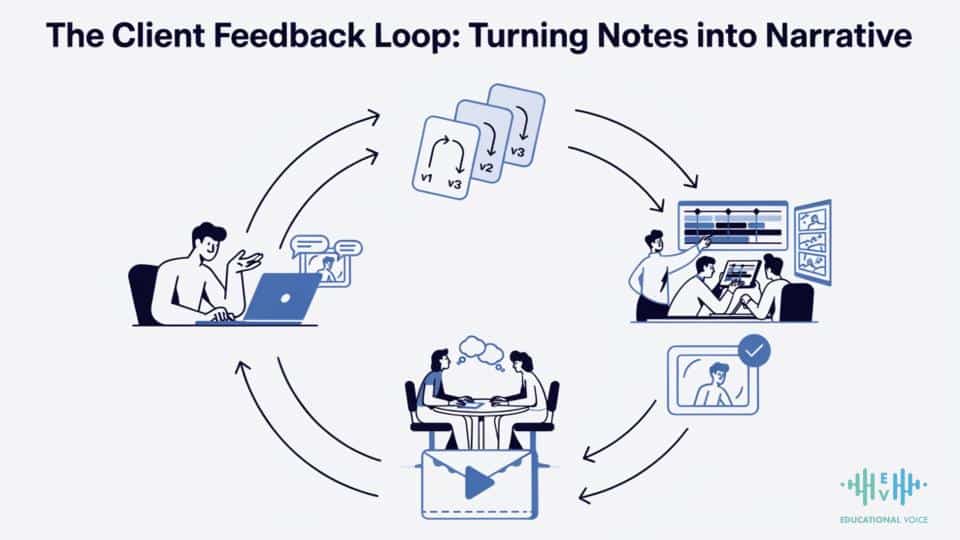
How a studio handles feedback matters as much as how it animates. A commercial animator’s afternoon is often built around what the industry calls the feedback loop: a client reviews a cut, leaves notes, and the team turns those notes into changes, usually against a tight turnaround.
A common pattern is the twenty-four-hour cycle. A client sends notes at the end of their working day; the animation team reviews them first thing the next morning, before the rest of that day’s dailies. This keeps a project moving even when the client and studio aren’t working the same hours, which matters for UK and Irish businesses working with studios across different regions.
Version control matters here too. A “version two” note might ask for a colour change or a re-timed transition; a “version three” note might ask for a full re-animation of a scene because the client’s product changed. Distinguishing between these early, rather than discovering the scale of a change halfway through, is what keeps a project within its agreed number of revision rounds rather than spiralling into extra cost.
Good feedback handling also depends on the client, not just the studio. Notes that describe the problem, “the pacing feels rushed in the middle section”, give an animator far more to work with than notes that only describe a preferred solution, “make it slower.” Educational Voice encourages clients to flag what isn’t working and let the animation team propose the fix, since the person who built the scene usually has several ways to solve a pacing or clarity issue that a client wouldn’t necessarily think to ask for.
“The hardest part of this job isn’t the animation itself; it’s translating a client’s note into the right creative decision. A vague comment like ‘make it feel more premium’ has to become a specific choice about pacing, colour, or sound. That’s where the balance between technical skill and understanding a client’s business objectives really shows.”, Michelle Connolly, Founder and Director, Educational Voice
If you’re planning your own project and want to see how this feedback structure works in practice, the team at Educational Voice is happy to walk you through it; you can get in touch to discuss your own animation project and how a typical review schedule would fit around your team’s availability.
Behind the Scenes in Belfast: The UK Animation Landscape
Northern Ireland’s animation and creative sector has grown steadily, and Belfast sits within that wider UK and Irish creative economy. For a business based in Belfast, Northern Ireland, Ireland, or elsewhere in the UK, working with a local studio brings practical advantages that aren’t always obvious from outside the industry.
Shared time zones mean feedback cycles like the one described above happen within a normal working day, rather than across a significant time difference. A studio based in the same market also understands local business culture, from how UK businesses typically brief a project to the regulatory context that shapes healthcare or financial services communications.
Educational Voice is based in Belfast and works with clients across Northern Ireland, Ireland, and the UK, producing 2D animation for education, business, and training. The studio’s founder, Michelle Connolly, brings a background as a former primary school teacher into that work, an unusual grounding for a commercial animation studio, but one that shapes how the team approaches explaining complex ideas clearly.
That teaching background has produced one of the studio’s most significant proof points: Educational Voice has created over 3,300 educational animations for LearningMole, a platform that has built an audience of 246,000 YouTube subscribers and more than 16 million views. Producing content at that volume, consistently and to a schedule, requires exactly the kind of disciplined daily process described earlier in this article. It’s also the kind of production history that’s harder to find outside a genuinely established studio.
“Being based in Belfast gives our team a genuine understanding of what UK and Irish businesses need from their animation. We know the market and the practical realities facing SMEs who need quality without an enterprise-level budget,” notes Michelle Connolly, Founder and Director of Educational Voice.
Beyond the Desk: Studio Culture and Creative Problem Solving

Animation is collaborative work, and a commercial animator’s day includes far more conversation than the “solitary artist” stereotype suggests. Character choices, pacing decisions, and colour treatments get discussed as a team, because a fresh pair of eyes catches problems that someone deep in a single scene can miss.
Short breaks away from the screen matter too, not as a luxury but as a practical part of maintaining quality across a demanding schedule. Animators who step away from a difficult scene and come back to it tend to spot issues faster than those who push through without a pause.
Problem solving in animation is rarely dramatic. It’s usually a small, practical conversation: does this transition read clearly at normal speed, does the colour choice clash with the client’s brand palette, does a character’s expression actually match the line being spoken over it. Those quiet checks, repeated across dozens of scenes, are what a finished commercial animation is actually built from.
This collaborative, well-managed studio environment is part of what Educational Voice’s clients are actually paying for, alongside the animation itself: a team that catches its own mistakes before a client ever sees them. You can read more about the team behind Educational Voice and how the studio approaches project delivery.
Hiring an Animator: What Brands Need to Look For
Everything above translates directly into vetting criteria if you’re choosing who to hire. Look first at the portfolio: does it show a clear progression from storyboard to finished animation, and does the finished work actually look consistent with what was promised at the brief stage?
Communication matters as much as technical skill. Ask how a studio handles feedback, how many revision rounds are included, and how quickly they turn around notes. A studio that can’t explain its own process clearly to you is unlikely to run a disciplined one internally.
Sector experience is worth asking about directly too. Healthcare and financial services animation, for example, often needs an extra layer of accuracy checking that a general marketing animation wouldn’t require, since a misleading visual in a regulated industry carries real consequences. A studio that’s produced work across several sectors, rather than only one type of project, will usually have a clearer answer for how they handle that additional scrutiny.
The Client Kick-off Checklist
Before an animator’s day on your project can properly begin, most studios will ask you to have ready:
- Brand guidelines (colours, fonts, logo files)
- A written script or key messaging points
- The aspect ratios you need (widescreen, square, vertical)
- Reference examples of a style or tone you like
- A realistic sense of your timeline and budget range
For a fuller breakdown of what professional animation typically costs and how long different formats take, Educational Voice’s blog covers animation costs and production timelines in more depth, which is worth reading alongside this article if you’re at the budgeting stage.
The Future of Commercial Animation in the UK
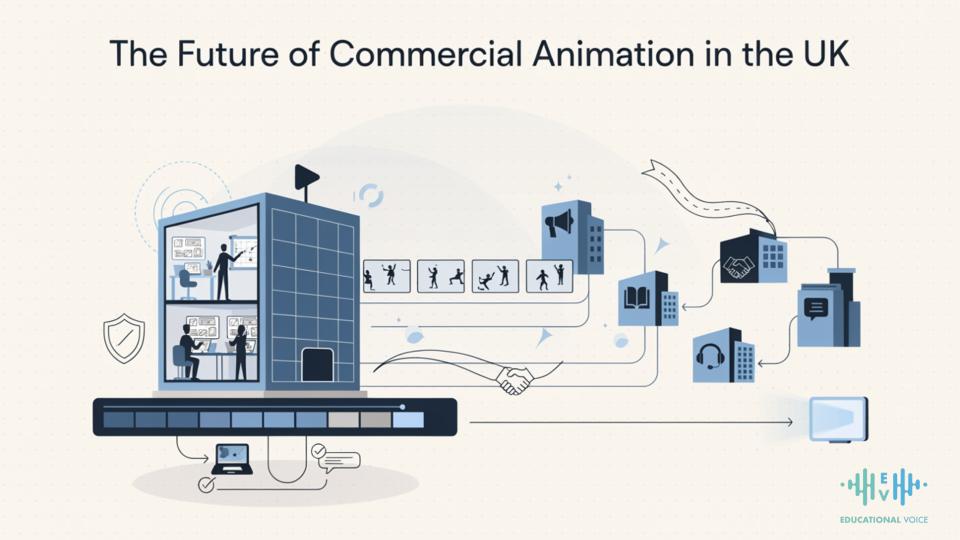
The daily routine described here, morning review, deep production work, tight feedback loops, and collaborative problem solving, is what actually delivers a finished commercial animation on time and on budget. None of it is glamorous in the way outsiders sometimes imagine, but it’s exactly what protects a client’s investment.
As UK and Irish businesses lean further into video and animated content for training, marketing, and customer education, studios that can explain this process clearly, rather than treating it as a black box, will keep earning trust from decision-makers who’ve never commissioned animation before. Educational Voice, based in Belfast, continues to build its work around that same principle: clear communication, disciplined production, and animation that does what it’s meant to do for the businesses that commission it.
None of this requires a business to become an expert in animation production. It requires choosing a studio that treats its own process as something worth explaining clearly, rather than something to keep hidden behind a finished file and an invoice.
FAQs
What is the typical turnaround for a 30-second commercial animation?
Most 30-second commercial animations take four to six weeks from a signed-off brief to final delivery. That includes storyboarding, animatic review, full animation, and at least one or two rounds of client revisions. Tighter turnarounds are sometimes possible for simpler styles, such as whiteboard or kinetic typography, but rushing the storyboard stage almost always costs more time later. Longer or more technical projects, such as detailed training animations, typically need closer to eight weeks.
What software do professional animation studios use?
Professional studios typically combine dedicated 2D animation software with separate compositing tools for effects and layering, plus a cloud-based review platform for client feedback. The specific tools matter less than how a studio uses them; strong storytelling and a disciplined process consistently produce better results than software choice alone, whichever package a given studio has settled on. Ask a prospective studio how their toolset supports feedback, not just production, since that’s often where projects lose time.
How many rounds of revisions are standard in a commercial animation project?
Most studio quotes include two to three rounds of revisions as standard, covering changes like pacing, colour, or minor script adjustments. Larger changes, such as reworking a whole scene because a client’s product or messaging shifted, usually sit outside that included scope. Agreeing this upfront in the brief avoids confusion and unexpected costs later in the project. It’s worth checking exactly what counts as a “round” before signing off a quote, since definitions vary between studios.
Do commercial animators work remotely or in-studio?
Many studios now run a hybrid model, with some work done remotely and key review sessions held together in person or via video call. In-studio collaboration still has real value for catching problems early, particularly during storyboard and animatic review, when a second opinion in the room can flag an issue that’s easy to miss working alone. What matters for a client is that review structure exists, whether the team sits together or connects remotely each day.
How do I choose between a freelance animator and a studio?
A freelancer can suit a small, single-format project with a flexible timeline, but a studio offers project management, quality control from multiple reviewers, and the capacity to scale if your needs grow. For business-critical content, such as training or sales animation, the added structure a studio provides usually outweighs any cost saving from going freelance. It’s worth asking either option for a portfolio and a clear revision policy before committing to a brief.
What is the “dailies” process in commercial animation?
Dailies are the short morning review meetings where a team checks the previous day’s work against the brief before continuing. They catch small issues, an odd movement, a drifting brand colour, a pacing problem, before those issues get built further into the animation. Studios that run consistent dailies typically deliver more predictable, on-schedule projects. As a client, you won’t usually sit in on these meetings, but you should expect to hear about anything a dailies review flags that might affect your deadline or brief.
Ready to discuss your animation project?
Educational Voice creates professional 2D animations for businesses across the UK. Whether you need educational content, explainer videos, or corporate training animations, our Belfast-based team is ready to bring your vision to life.
Contact Educational Voice to discuss your project requirements.


